

Overconsumption in the fashion industry has become an increasingly prevalent issue worldwide. Clothing retailers using low-quality materials, quick turnover of fashion trends -- there are many factors that contribute to the increasing rates of textile waste.
In Australia, over 590,000 tonnes of fabric and textile waste are sent to landfills every year. Opportunity shops are getting oversaturated with donations and are disposing of large quantities of clothing themselves. And this is for the clothes that are still intact, so what do you do if they're torn?
Many businesses are already innovating to address these growing concerns, but for the general public, there is little visibility into the work being done.
How might we help Australians find meaningful ways to dispose of their textile waste?
The Problem


Who is this for?

Fashion is ever-changing. Trends come and go at an increasingly rapid rate, especially with the influence of social media. So once you're done with your clothes, what happens to them?
Textile waste is actually a huge problem in Australia. Each individual throws out, on average, 23 kilograms of clothing every year. And with a population of over 25 million, it all adds up. Over 590,000 tonnes of our textile waste end up in our landfills every single year.
But wait... what about donation? Unfortunately, many Australian charities are oversaturated with clothing, so much so that they spend $13 million yearly sending unusable donations to landfill.
So what can you do if you want to do the right thing, but don't know where to start?
The consciencous Australian
When we were looking at target demographics that faced the largest barriers to donating and/or sustainably disposing of their unwanted clothing, we identified 2 key demographics.
Key Demographics
01 Young Adults
• Cost-sensitive
• Busy schedule between uni and work
• Desire to implement sustainable habits
02 Parents
• Time poor and always on-the-go
• Collects clothes from the entire family
• Growing kids go through clothes quickly
What is our business concept?
How might we...
Remove barriers faced by Australians that are preventing them from disposing of clothes sustainably, to empower them now and into the future, so we might close the existing intention gap?
Introducing
Save Our Clothes (S.O.C)
We aim to close intention gaps to sustainable disposal of textiles and clothes by making donating convenient and impactful for everyday Australians.
Educational
Promotes a variety of initiatives and provides tips on sustainable living.
Transparent
Helps you visualise your eco-social impact, and track your donations.
Convenient
Collects all kinds of clothing and fabric right from your doorstep.
Save Our Clothes brand is all about sustainability and trust. We had a little bit of playfulness with our brand, as we identified that for our target audience in Australia, this is one of the best ways to start building rapport with our customers.
We want to create an experience that is viewed as a friend and advisor. I kept the main concept of the logo quite simple, with just a singular outline of a sock (for the name) and a leaf (for sustainability). This design adds a visualisation to our general motto:
Sustainable disposal of your clothes can be simple too!
The Brand
Colour Palette
Type

Logo

Prototypes
To test the concept of our business, the team brainstormed what our riskiest assumptions. Generally speaking, we found that, for our target demographic, being more intentional about disposing of their textile waste is a matter of effort, ease, and/or personal cost.
We believe that if we make sustainably getting rid of clothes as easy as throwing them out, people will naturally transition to our business because they can do good without having to go out of their way. However, we needed to be able to validate our idea, so the main hypothesis I wanted to challenge in user interviews was:
The Hypothesis
If we charge consumers for our service, then people will be heavily discouraged from transitioning to our business because our consumers value convenience - and its related costs - over the virtually unseen sustainable impact of their disposal methods.
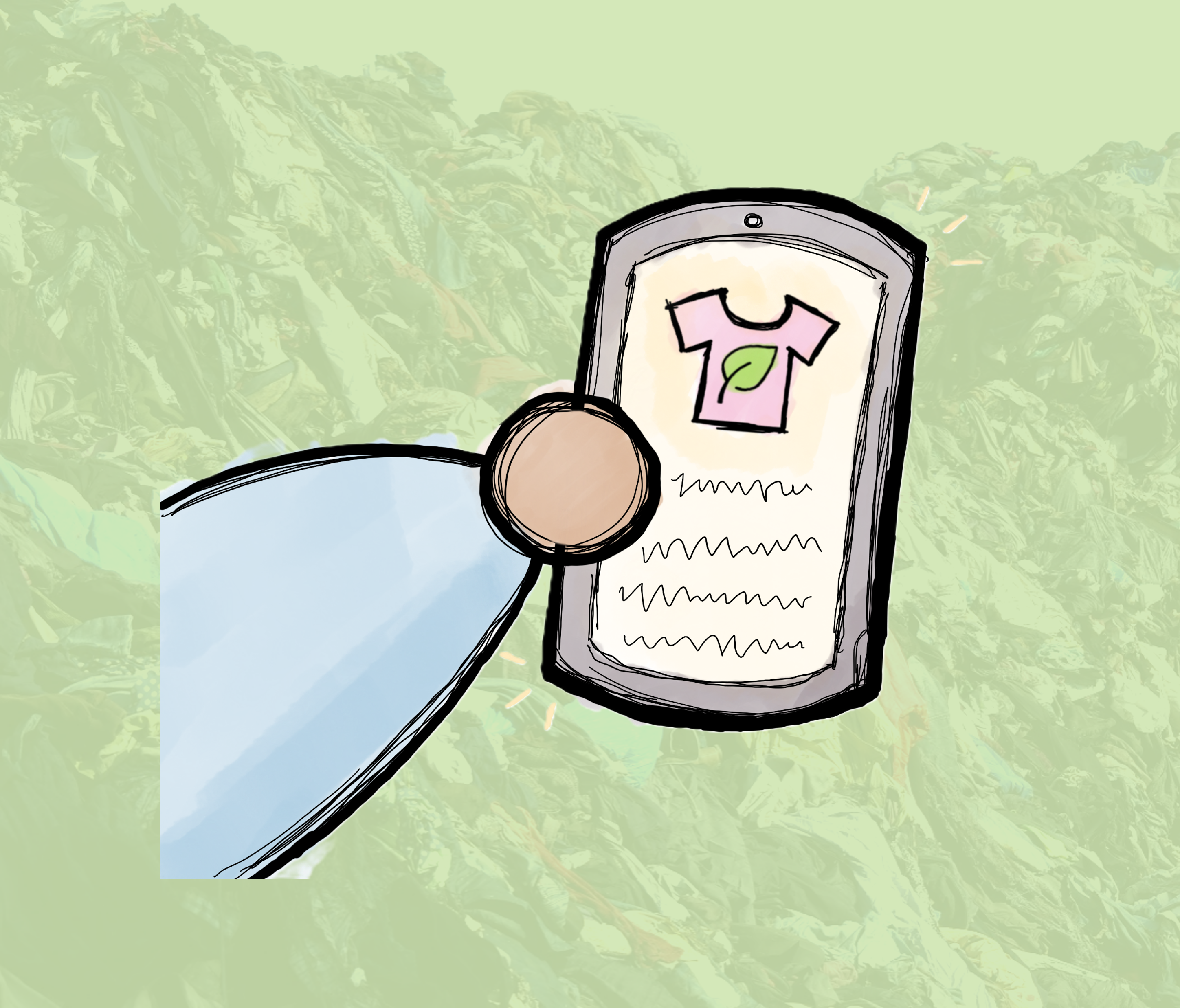
Looking over what information I needed to obtain, I decided to create storyboards to illustrate the process we were considering for our service.
For the purposes of showcasing in user interviews, I split the process of using the service into 10 different actions:
Our Service

01
You hear about our company
• Reduce your impact on textile waste
• No need to sort out your unwanted clothes
• We pick it up at your door
• As easy as throwing out your clothes

02
You sign up to use the service
• Give us your details
• Preferred form of contact
• Address for pickup
• You're ready to go!

03
Choose your preferred initiatives
• Find information on each initiative
• What they do and why
• What you can donate
• Favourite companies you want to donate to

04
Start collecting your clothes
• Set aside the clothes you want to donate
• Don't worry about the state of your clothes
• Stains/holes are fine
• Leave the sorting to us

05
Receive your starter pack
• Includes bag/box to put your clothes in
• Bright colours and designs
• Has our logo so you know where it goes
• Doesn't blend in with other bags/boxes

06
Select a date for pickup
• Your bags/boxes are ready for donation
• Choose a date for us to come by
• Once-off or scheduled
• No need to plan around donating

07
Clothes are picked up from your home
• Just leave your bags/boxes outside
• Go about your day, we'll pick them up
• You are notified once they are collected
• Replacement/bags are left for next time

08
We sort and donate your clothes
• You are notified once clothes are donated
• We provide you with details on donations
• List of initiatives you're supporting
• Percentage of your clothes sent to each

09
Your personalised impact report
• You receive a yearly impact report
• How much you've donated
• List of initiatives supported
• Your positive environmental impact
• Your favourite businesses' achievements

10
Suggested initiatives based on preferences
• We send you information on new initiatives
• Suggestions based on your favourites
• Links provided to their websites
• Only sent periodically

One of the most glaring issues that I identified, and definitely tried to avoid by using a storyboard, is telling my interviewees how they should be using the service.
Not addressing this would mean that I would miss out on valuable insight into:
• How this service could be more useful to our customers
• Issues and concerns that are thought of at each step of the way
• Other ideas that we might not have thought of
To ensure I could get the most value from both my prototype and my interviews, I decided to use these interviews as an opportunity to co-design with my interviewees.
To avoid influencing their answers with my illustrations, I would ask questions like “How would you imagine this looking?” before each slide -- only showing them the description of the step and elaborating in words -- to get their most honest reactions and comments.
Testing the hypothesis
So... would customers pay for this service?
To my surprise, the hypothesis was disproven. The interviews I conducted showed that people find value in this business plan, and a majority of our target customers would gladly pay a small fee to use this service.
There are a few features that our users value most from the service. The top three are:
Interview Findings
Convenience:
Having the clothes picked up at their house, without needing to be there
Visibility:
Knowing which initiatives their clothes are being sent to
Impact:
Knowing how their actions have contributed to sustainability outcomes
Final business model

Mockups
For this project, the creation of user interfaces as a prototype was secondary to the main objective: service design.
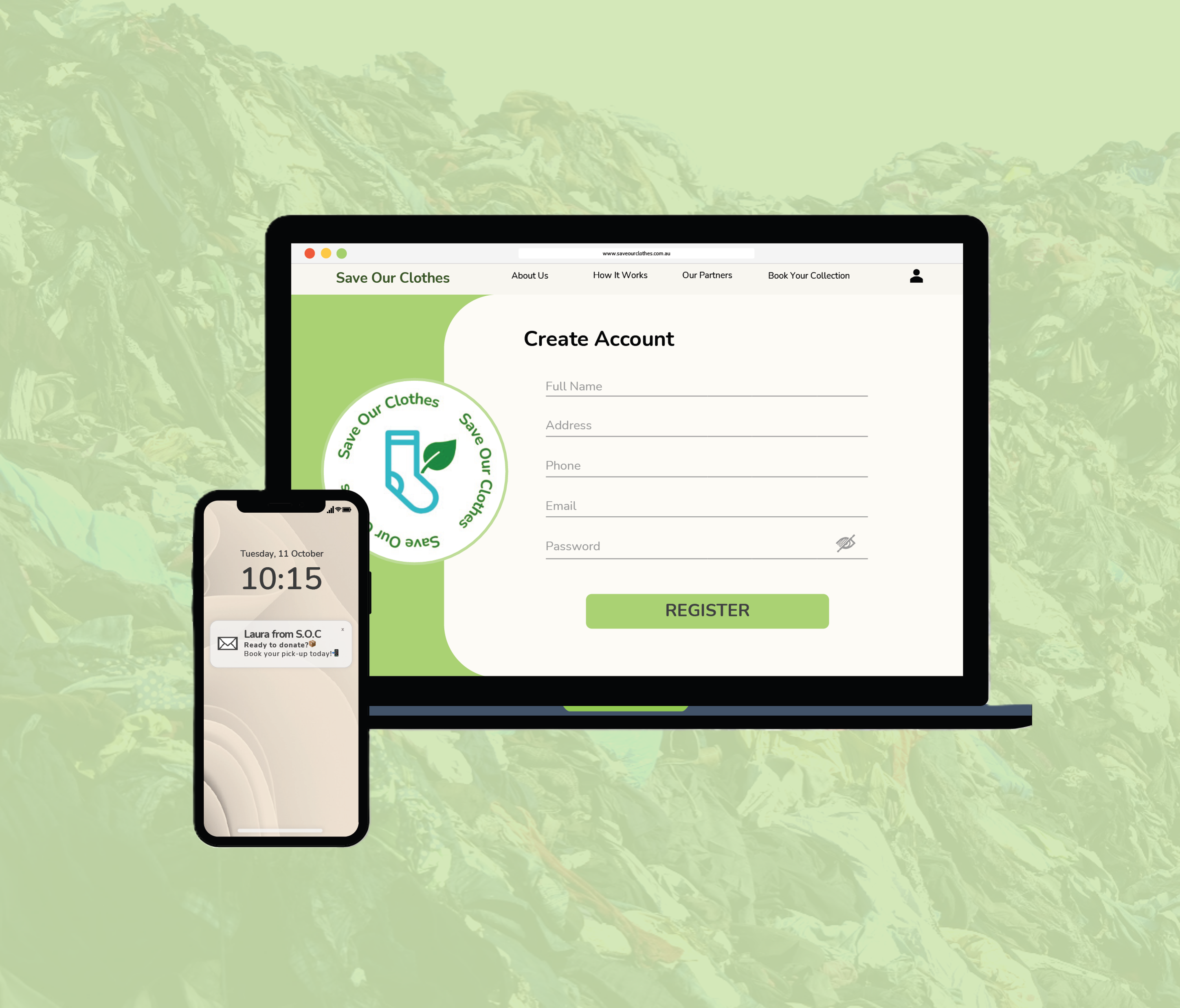
I created a quick mockup for the login interface and an email notification to help support the business concept and user journey.
In future, Save Our Clothes would require a website --with a mobile-first design-- so that users can easily find the information they need from our service.

This is a project that I really enjoyed working on, as the subject matter is close to my heart. Learning more about the impact fast fashion has on our environment was insightful.
User interviews also showed that this issue is a prevalent concern in the minds of the Australian public at the moment. It proved that people want to do the right thing for our environment, but the barriers around sustainability can feel too great.
This project helped highlight that a great user experience doesn't necessarily start with the digital interfaces, but rather the service design and connection with the business and their community.